
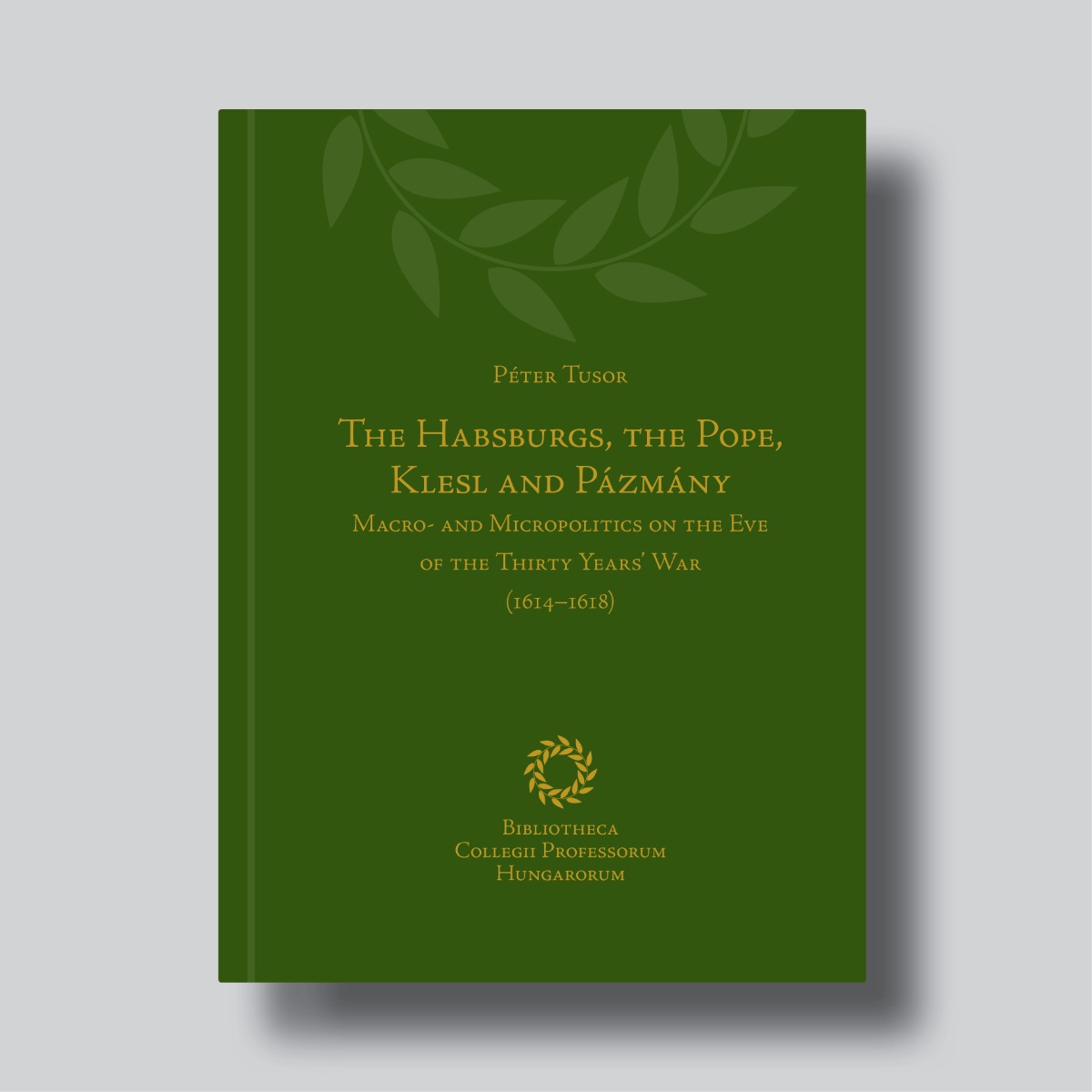
Péter Tusor, The Habsburgs, the Pope, Klesl and Pázmány: Macro- and Micropolitics on the Eve of the Thirty Years’ War (1614-1618) (Bibliotheca Collegii Professorum Hungarorum), Piliscsaba, Makovecz Campus Alapítvány, 2025. ISBN: 978615825666
A monográfia témája Pázmány Péter prímási kinevezése. A kora újkori magyar történelem egyik legnagyobb hatású makropolitikai tényének körülményeit, okait, célját, összefüggéseit elemzi a – korszakra Wolfgang Reinhard által kidolgozott – „mikropolitikai” megközelítésben, fordulatos eseményeit rekonstruálja kritikai igénnyel. A kérdés Pray Györgytől kezdve harmadfél százada áll a magyar historiográfia érdeklődésének homlokterében. Mégis csupán részleges, vagy kifejezetten téves eredmények születtek. A kötet egyaránt felölel politika-, diplomácia- és egyháztörténeti dimenziókat, sőt a művészettörténet is új eredménnyel gazdagodik. Bátran él a latin és olasz szövegfilológia eszközeivel, és segédtudományként világi- és kánonjogtörténettel.
Külön fejezet tárgyalja a Habsburg- és a pápai diplomácia elhúzódó tárgyalásait, Pázmánynak a jezsuita rendből átmenetileg kifelé vezető útját, az ezt övező rendi feszültséget, vádakat, szomaszka novícius-jelöltségét stb. Fény derül támogatóira és szépszámú ellenségeire. Eldől, hogy kinevezése tényleg aggályos volt-e egyházjogilag, avagy mégsem, volt-e gyereke, vagy mégsem, fűtötte-e becsvágy, akart-e egyáltalán Magyarország prímása lenni, illetve kinek állt leginkább érdekében, hogy azzá tegye őt, és végül ki lett kinevezésének legfőbb haszonélvezője. A római és a prágai udvar belső viszonyai és az európai nagypolitika elemzése nyomán tárulnak fel a páratlan karrierfordulat okai, mozgatórugói a harmincéves háború kitörésének előestéjén.
A szerencsés forrásadottságoknak és az itáliai, osztrák, cseh és magyar levéltárakra kiterjedő széleskörű feltáró munkának köszönhetően az olvasó történeti megismerhetőség különleges mélységeibe juthat el négy évszázad távlatából. E mélységekbe elsődlegesen a római Habsburg diplomáciai és egyházi képviselet mindeddig homályban rejtőző informátorai kalauzolnak el.
The subject of the monograph is the appointment of Péter Pázmány as the primate of Hungary. It analyzes the causes, aims and interrelations of one of the most influential macro-political facts of the early modern Hungarian history with micro-political approach – a technique that was elaborated for the age by Wolfgang Reinhard – and reconstructs its twisting events with critical sense. The question has attracted increasing attraction of the Hungarian historiography for three centuries starting out from György Pray. Yet only partial or false answers were found. The volume encompasses political, diplomatic and church-historical dimensions; what is more, it enriches also the art history by a new result. The author confidently uses the results of the Latin and Italian philology and – as auxiliary sciences – secular and canon law history.
Separate chapters deal with the protracted negotiations of the Habsburg and the papal diplomacy, the way of Pázmány leading temporarily out of the Jesuit order, the surrounding tensions inside the order, the accuses, the Somascan novice-candidacy, etc. Both his supporters and a fair number of his enemies are unfolded in the volume. Furthermore, we get an answer to the question whether his appointment was really problematic from the point of view of canon law or not, whether he fathered a child or not, whether he was heated by ambition and so wanted to be the primate of Hungary at all; who interested mostly in filling this position with him, and finally who became the main beneficiary of his appointment. The causes and driving force of the unique career turnaround are revealed analyzing the inner relations of the Court of Rome and Prague and the European high politics on the eve of the break out of the Thirty Years’ War.
The reader can dive into the special depths of historical cognition from the perspective of four centuries due to the fortunate source facilities and the wide exploring work covering Italian, Austrian, Czech and Hungarian archives. In these depths the interested are led primarily by the Roman Habsburg diplomatic and ecclesiastical informers whose role remained unknown until now.